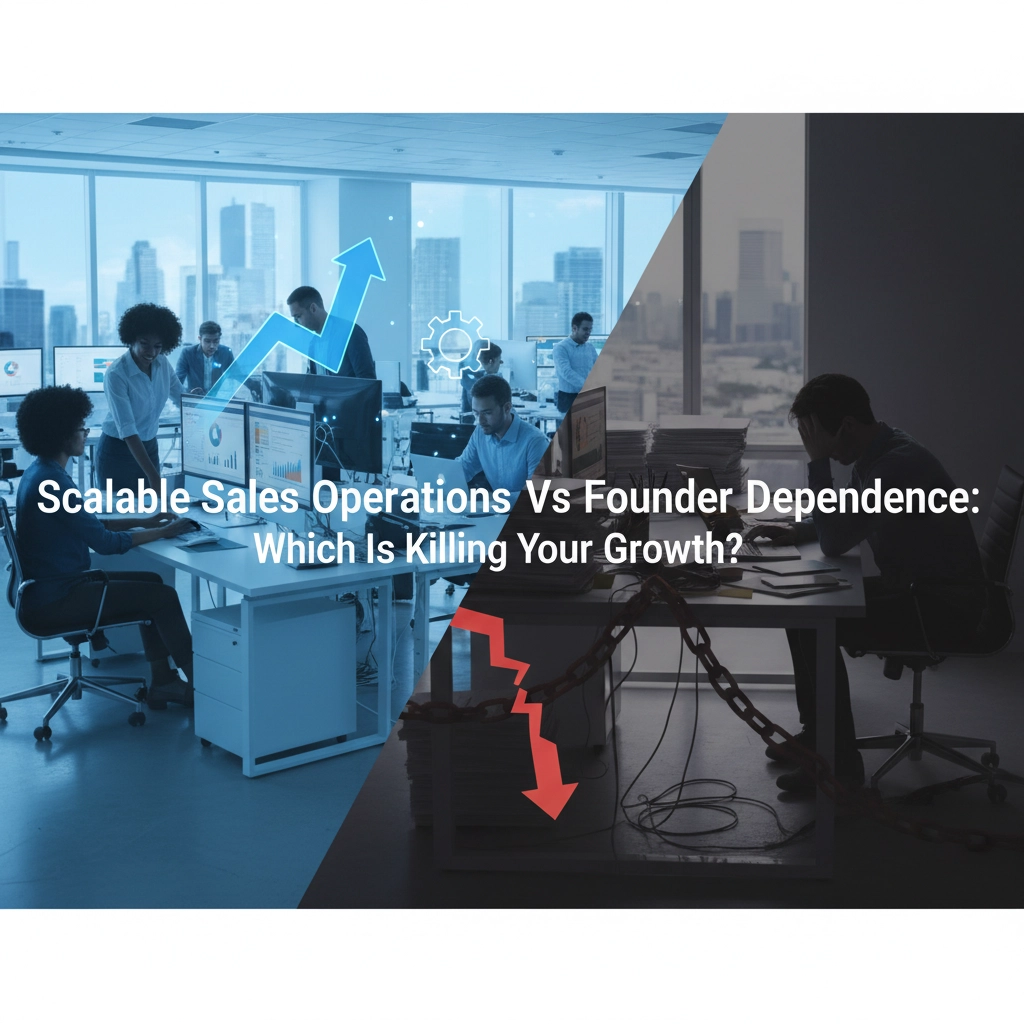
Here’s what separates companies that scale from those that stay stuck: The best performers focus as much energy on their sales operations as they do on selling itself.
In 2025, 82% of sales professionals report that sales operations plays a critical role in their business growth. Yet most founders are still trapped in the same cycle: their top salespeople can’t document what they’re doing, so they never escape the selling role, and the company never scales beyond what a few heroes can individually achieve.
Look, I get it. Your star performer closes deals like clockwork. They bring in 40% of your revenue. But here’s the thing: if they can’t teach someone else to do what they do, you don’t have a business. You have an expensive hobby.
The Founder Trap: Why Your Best People Stay Stuck

Your top producers are trapped, and they don’t even know it.
They wake up every morning knowing they need to generate leads, make calls, and close deals. But ask them exactly how they do it, and you’ll get vague answers like “I just build relationships” or “I have a good feel for people.”
This isn’t their fault. Most high performers operate on intuition. They’ve developed patterns that work, but they can’t break down those patterns into teachable systems. So they stay in the selling role forever, becoming the bottleneck that prevents your company from scaling.
Meanwhile, companies that successfully scale have cracked a different code entirely. They’ve figured out how to document, systemize, and replicate their sales success. They don’t just sell: they build operations that sell.
The Four Pillars Companies Use to Scale Sales Operations
The companies that consistently generate leads and scale their revenue have mastered four critical areas:
1. Lead Generation Systems (Not Just Lead Generation)
Successful companies don’t just “get leads”: they build predictable systems that generate qualified prospects on autopilot. They know exactly:
- Which marketing channels produce their best customers
- What content moves prospects through their pipeline
- How many touches it takes to convert a cold lead
- Which follow-up sequences have the highest response rates
When Adobe restructured their sales operations in 2023, they increased lead conversion rates by 35% simply by documenting and optimizing their lead qualification process.
2. Documented Sales Processes (Not Just Sales Skills)
Here’s where most companies fail: They hire great salespeople but never document what great selling actually looks like in their specific business.
Companies that scale create detailed playbooks that include:
- Exact scripts for common objections
- Step-by-step qualification frameworks
- Specific questions that uncover buying triggers
- Proven closing sequences that work in their industry
This works because new hires can ramp up in weeks instead of months, and your revenue becomes predictable instead of personality-dependent.
3. Winner Recruitment Formulas (Not Just Hiring Good People)

Scaling companies don’t just recruit winners: they know exactly what a winner looks like for their specific sales process. They’ve identified the personality traits, experience markers, and skill sets that predict success in their environment.
Google’s sales hiring process includes 47 specific criteria that correlate with sales performance in their organization. They don’t hire “good salespeople”: they hire people who will succeed at selling Google’s solutions to Google’s target market.
4. Performance Systems (Not Just Performance Management)
The best sales operations teams create systems that make it impossible for performance to slip through the cracks. They track leading indicators, not just results:
- Activity metrics that predict future sales
- Pipeline velocity measurements
- Conversion rates at each stage
- Time-to-close by deal size and source
Sales operations boosts productivity by 20-30% annually because it removes the guesswork from performance management.
Why Documentation Changes Everything
Here’s what I’ve learned after working with hundreds of companies: Your sales process only exists if it’s documented.
If your top performer gets hit by a bus tomorrow, can someone else step into their role and maintain 80% of their results within 30 days? If not, you don’t have a sales process: you have talented individuals doing whatever works for them.

Documentation isn’t just about training new people. It’s about creating a feedback loop that improves your entire sales operation:
- You can identify bottlenecks in your pipeline when you track each step
- You can optimize conversion rates when you A/B test different approaches
- You can forecast accurately when you understand your sales velocity
- You can scale confidently when you know what works and why
McKinsey research shows that companies with documented sales processes see 28% higher revenue growth than those relying on individual performance alone.
Breaking Free: From Hero Sales to Team Success
The transition from hero-dependent sales to scalable operations requires a fundamental shift in thinking. Instead of asking “How can I sell more?” start asking “How can we sell consistently?”
This means your star performers need to become teachers, not just closers. They need to document their prospecting methods, their discovery questions, their objection-handling techniques, and their closing strategies.
Look, this isn’t easy. Your top performers might resist this change because their value has always been tied to their individual results. But here’s the thing: in a scalable business, their value becomes their ability to create more people who can deliver those results.
Companies that make this transition successfully see predictable outcomes:
- 40% reduction in ramp time for new hires
- 25% improvement in forecast accuracy
- 35% increase in team quota attainment
- 50% reduction in manager time spent on individual coaching
The Real ROI of Sales Operations

When you invest in sales operations, you’re not just improving efficiency: you’re creating sustainable competitive advantages:
Predictable Revenue Growth: You can accurately forecast quarterly and annual results because you understand your pipeline mechanics.
Scalable Hiring: You can confidently add salespeople because you know exactly what success looks like and how to train for it.
Market Responsiveness: You can quickly adapt to market changes because your processes are documented and flexible.
Leadership Freedom: You can step away from day-to-day sales activities because your team operates from proven systems, not individual heroics.
The most successful CEOs I work with spend 60% of their time on sales operations and only 40% on direct selling. They’ve learned that building the machine is more valuable than operating the machine.
Your Next Step: From Chaos to Consistency
If you’re tired of revenue that depends on individual performance, it’s time to build sales operations that create consistent results regardless of who’s doing the selling.
The companies that scale successfully in 2025 will be those that master the transition from hero sales to systematic operations. They’ll document what works, train what’s documented, and measure what matters.
Ready to break free from founder-dependent sales and build a revenue engine that scales without you?
Join our exclusive webinar where we’ll show you exactly how to:
- Document your top performer’s process into teachable systems
- Create lead generation that runs on autopilot
- Build hiring criteria that predict sales success
- Design compensation plans that drive the right behaviors

Register now at: https://sales.leadershipsalestraining.com/webinar-registration
Your future self: and your sales team: will thank you for making this shift from selling harder to selling smarter.