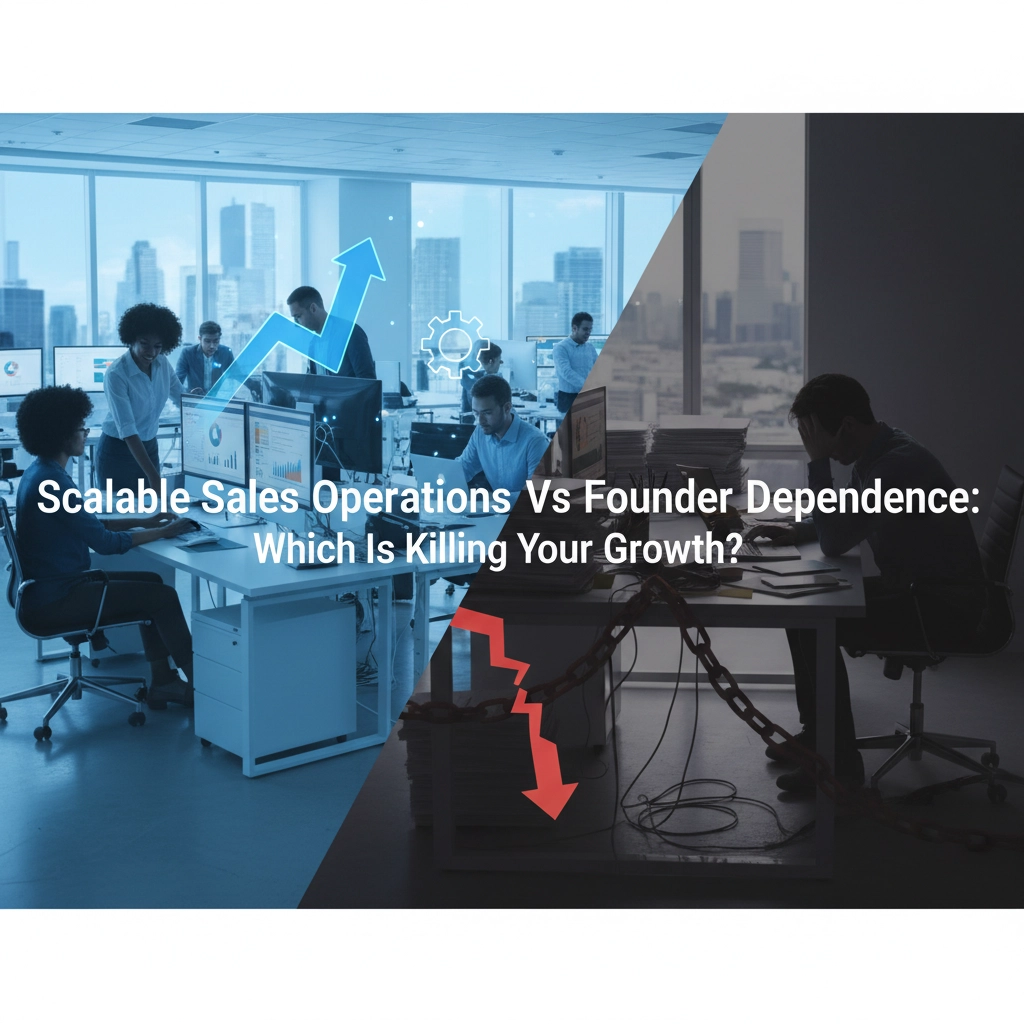
Here’s the uncomfortable truth: founder dependence is the silent killer of growth in 2024.
Not founder-led sales in its early stages: that’s actually essential. But the moment you cling to being the only person who can close deals past your first $1-3M in revenue, you’ve installed a permanent ceiling on your business.
Look, I get it. You built this thing from scratch. You know every feature, every benefit, every objection before the prospect even thinks it. But here’s what 68% of B2B founders don’t realize until it’s too late: what got you here won’t get you there.
Why Founder-Led Sales Works (At First)

In the beginning, founder-led sales isn’t just natural: it’s your secret weapon. You’ve got every advantage that matters:
- Passionate belief that’s impossible to fake
- Deep product knowledge that builds instant credibility
- Decision-making power to pivot deals in real-time
- Authentic relationships with your early customer base
- Consultative approach that feels genuine (because it is)
Your early sales conversations aren’t just transactions: they’re research sessions. You’re learning what resonates, testing messaging, and evolving your entire business model simultaneously.
This personal drive paired with product expertise builds immediate credibility. According to Salesforce research, founder-led companies see 23% higher close rates in their first two years compared to those with hired sales teams from day one.
Where The Ceiling Forms (And Growth Dies)
But here’s where it gets dangerous. The very strengths that made founder-led sales effective become liabilities as you scale.
The math is brutal. One founder can only take so many calls, sit in so many meetings, and close so many deals. Your sales capacity is literally constrained by the hours in your day.
Here’s what happens next:
- Leads start waiting longer for responses
- Sales momentum stalls when you’re pulled into operations
- Valuable opportunities slip through cracks during busy periods
- Your team feels helpless because they can’t replicate your “magic”
- Growth plateaus despite increasing market demand
McKinsey found that 73% of founder-dependent companies hit a revenue plateau between $1-5M and stay there for 18+ months. Why? Because they confused being irreplaceable with being indispensable.
The Hidden Costs Killing Your Business

Most founders underestimate what staying in the sales seat too long actually costs. The damage goes way beyond visible revenue loss:
1. Slowed Growth (The Obvious One)
When every deal requires your personal involvement, growth becomes linear instead of exponential. While competitors with scalable systems are doubling revenue year-over-year, you’re stuck adding deals one-by-one.
2. Damaged Business Valuation
Here’s what investors and buyers actually see when they look at founder-dependent businesses: risk. If your customer acquisition strategy can’t survive without you, your exit options become limited and undervalued.
A business that can’t function without its founder is worth 40-60% less than one with repeatable, transferable systems, according to Bain & Company research.
3. Founder Burnout
The pressure of being the only person who can close deals creates relentless stress. Back-to-back meetings, piling leads, and constant revenue responsibility eventually exhaust even the most passionate founder.
You lose the strategic headspace needed for innovation, fundraising, and building the company you actually envisioned.
4. Inconsistent Team Execution
Your team hasn’t lived your journey. Without documented processes or clear guidance, they’re forced to improvise: and improvised sales rarely scale.
This creates frustration on both sides. The team feels like they’re guessing, and you feel like nobody can sell like you do.
The Scalable Operations Advantage

Companies that successfully break free from founder dependence share one trait: they treat scaling as a design problem requiring the same creativity they applied to building their product.
The key shift? Translating your instincts into a system that others can understand, trust, and execute.
This doesn’t mean losing authenticity. It means codifying what makes your approach effective so it can be taught, refined, and scaled.
Here’s What Changes:
Structured Problem Solving becomes possible when sales is no longer chaotic and founder-dependent. Managers can coach with purpose, teams speak a common language, and you finally have freedom to focus on growth.
Predictable Revenue replaces the feast-or-famine cycle. When your sales process is documented and repeatable, forecasting becomes reliable instead of guesswork.
Competitive Advantage emerges while competitors stay stuck playing “hero ball.” While they’re answering every call and approving every decision, you’re focused on scaling.
Adobe saw 340% revenue growth in 18 months after implementing scalable sales operations. Google’s early transition from founder-led to systematic sales enabled them to scale from startup to global dominance.
The 4-Step Transition Framework

Making this transition requires a structured approach. Here’s the framework that works:
Step 1: Audit Your Current Reality
Identify the real friction points. Is it the sales process itself? Messaging? Manager capability? Or unclear roles?
Document everything you do in a typical sales cycle: even on a napkin initially. The goal is capturing your knowledge so the broader team can leverage it.
Step 2: Reframe Sales as Problem-Solving
Shift from viewing sales as pressure or persuasion to structured problem solving. This mindset change makes the process teachable and scalable.
Create simple frameworks your team can follow:
- Discovery questions that uncover real needs
- Qualification criteria that identify ideal prospects
- Closing techniques that feel consultative, not pushy
Step 3: Build Systems Incrementally
Start lightweight with documented processes, then graduate to CRM systems like HubSpot, Salesforce, or Close that can scale with your business.
Don’t try to build everything at once. Focus on the biggest bottlenecks first.
Step 4: Test, Measure, Adapt
Be willing to adjust your systems when they’re not working. The best scalable operations evolve based on real performance data.
Track leading indicators like response rates, meeting-to-close ratios, and average deal cycles: not just revenue.
The Bottom Line
The question isn’t whether you can afford to delegate and systematize: it’s whether you can afford not to.
While you’re manually handling every lead, your competitors with scalable operations are:
- Closing deals while you sleep
- Training new reps in weeks instead of months
- Scaling revenue without scaling headaches
- Building valuable, transferable assets
The founders who recognize this early and act on it are the ones who break through the growth ceiling. The ones who don’t? They stay stuck at the same revenue level for years, wondering why growth feels so hard.
Ready to break free from founder dependence? The choice is yours: but the window for easy transition gets smaller every quarter you wait.
Your future revenue (and your sanity) depends on making this shift. The question is: will you make it before your competitors do?
I’m hosting a live masterclass where I break down the exact 4-step system employers use to get their entire team selling like the top producer—without micromanaging, motivating speeches, or sitting in every deal.
You’ll learn:
- How top performers actually think (so you can replicate it)
- The process that turns instinct into repeatable skill
- How to remove founder-dependence without losing revenue
- What to install so results compound after you step back
No theory. No hype. Just the system.
👉 Register here:
https://sales.leadershipsalestraining.com/webinar-registration
If you want a sales team that performs without you carrying the pipeline—this is where it starts.